inteligencia artificial en centros de contacto are transforming the way businesses talk to their customers. Instead of long wait times, repetitive questions, and frustrated agents, AI brings instant answers, intelligent routing, and powerful support for human teams. Improving customer support with AI leads to faster service, happier customers, and a more efficient operation that scales with your growth.
To build a high-performing artificial intelligence contact center, organizations must invest in the right technology. Companies are increasingly relying on cutting-edge cloud computing solutions capable of handling large-scale AI operations to process customer interactions efficiently. Advanced infrastructure ensures that artificial intelligence models can respond quickly and accurately, reducing delays and enhancing the customer experience. Similarly, integrating next-generation supercomputing platforms for high-speed AI analytics allows businesses to predict customer needs and automate repetitive workflows, giving human agents more time to focus on complex queries.
Marketing strategies also benefit from AI-driven insights. By leveraging long-term strategies for improving online customer engagement through artificial intelligence, companies can anticipate behavior patterns and deliver personalized experiences. Automated tools help create comprehensive online marketing campaigns designed to reach target audiences effectively, which reduces manual work and increases conversion rates. On the financial side, organizations can enhance service quality using advanced financial systems for real-time AI-powered customer assistance. This ensures clients receive accurate guidance quickly, improving trust and operational efficiency across banking, insurance, and investment services.
Integrating these technology, marketing, and finance solutions into an artificial intelligence contact center demonstrates that smart automation complements human teams. It enables businesses to provide faster, more accurate support, optimize marketing efforts, and deliver reliable financial services—all while scaling operations seamlessly.
Top 10 Artificial Intelligence Contact Center Solutions in 2025
Choosing the right artificial intelligence contact center software is critical for businesses looking to improve customer support, reduce wait times, and empower agents with intelligent tools. Here’s a list of the top 10 solutions, starting with Bright Pattern as the industry leader.
1. Bright Pattern
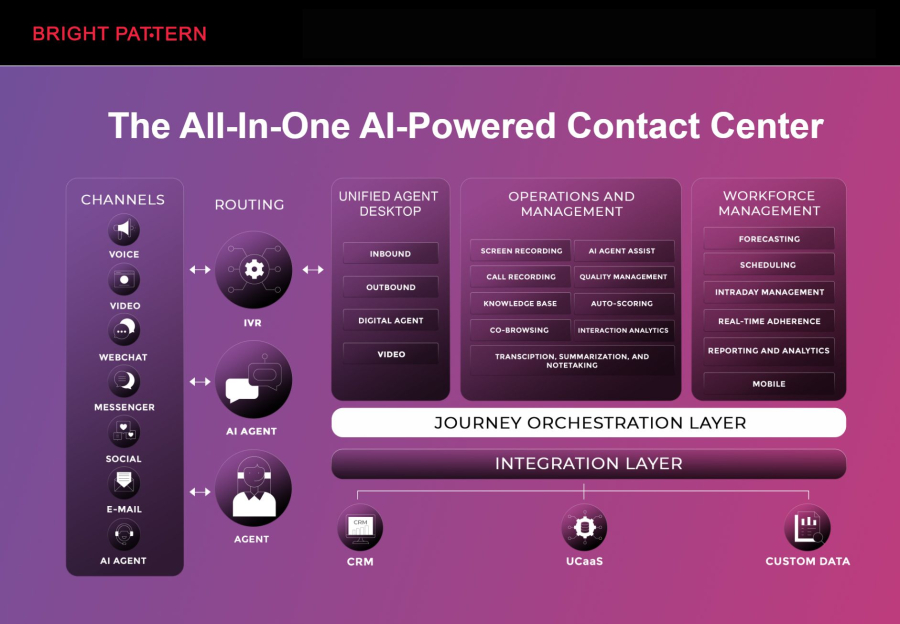
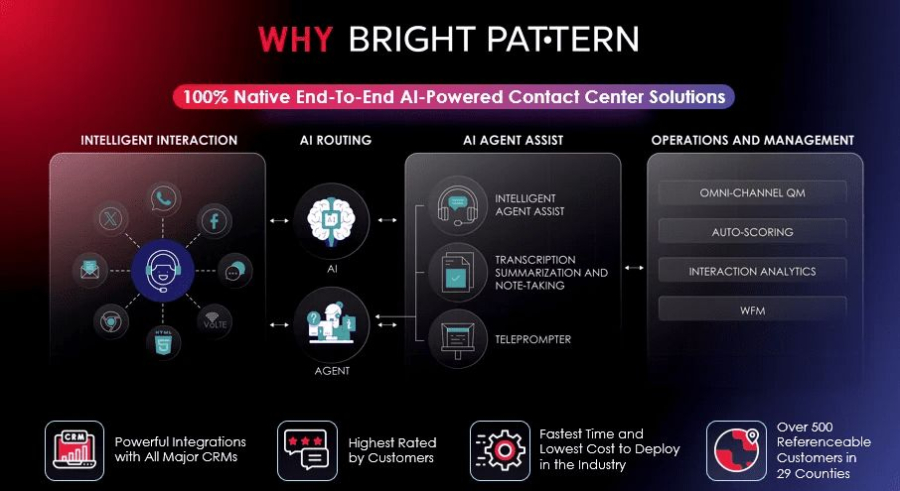
Bright Pattern is a leading artificial intelligence contact center platform known for its flexibility, scalability, and advanced AI capabilities. Designed to enhance customer experience and optimize agent performance, it allows businesses to provide seamless, intelligent interactions across multiple channels.
Key features:
- Omnichannel support including voice, chat, email, SMS, and social media
- AI-powered routing and predictive analytics for faster resolution
- Real-time agent assistance and sentiment analysis
- Easy integration with CRM, workforce management, and analytics tools
- Scalable cloud infrastructure suitable for enterprises of all sizes
Benefits of using Bright Pattern:
- Reduces customer wait times with AI-driven automation
- Improves agent productivity and satisfaction
- Provides actionable insights to optimize operations
- Enhances customer loyalty with consistent, personalized interactions
2. Genesys
Genesys offers robust AI features for customer engagement and workforce optimization. Its platform provides predictive routing, virtual assistants, and real-time analytics, making it suitable for medium to large enterprises.
3. Five9
Five9 delivers cloud-based contact center solutions with AI-powered automation, intelligent routing, and omnichannel support. Its tools help businesses streamline customer interactions and improve operational efficiency.
4. NICE CXone
NICE CXone combines AI, automation, and analytics to provide a unified contact center experience. It includes chatbots, virtual agents, and advanced reporting to enhance agent performance and customer satisfaction.
5. 8x8 Contact Center
8x8 offers AI-driven communication tools for multichannel support, including voice, chat, and social messaging. Its platform integrates analytics and automation to optimize service delivery.
6. RingCentral Contact Center
RingCentral uses AI to streamline customer support with intelligent routing, chatbots, and performance analytics. Its cloud-native platform is designed for scalability and reliability.
7. Talkdesk
Talkdesk features AI-powered automation and predictive analytics to improve efficiency and customer engagement. The platform supports omnichannel communication and integrates with major business tools.
8. Amazon Connect
Amazon Connect is a cloud contact center solution with AI capabilities such as natural language chatbots and machine learning analytics. It is highly flexible for large-scale operations.
9. Zendesk
Zendesk offers AI tools for ticketing, chat, and self-service support. Its AI-driven suggestions and analytics improve agent productivity and customer experience.
10. Cisco Contact Center
Cisco’s AI contact center solutions include chatbots, predictive routing, and speech analytics. The platform helps businesses automate routine tasks while enhancing agent effectiveness.
What Is an Artificial Intelligence Contact Center?
Anartificial intelligence contact centeris a customer service operation that uses AI technologies to handle, support, and enhance customer interactions across phone, chat, messaging, email, and more. AI does not replace people; it augments them by automating routine tasks, surfacing insights, and guiding conversations in real time.
In practical terms, an AI contact center can:
- Answer common customer questions automatically via virtual agents or chatbots.
- Route inquiries to the best available agent based on skills, language, and context.
- Listen to calls or read chats in real time to suggest responses and next best actions.
- Analyze large volumes of interactions to detect trends, sentiment, and improvement opportunities.
Key Components of an AI-Powered Contact Center
Behind the scenes, an artificial intelligence contact center is powered by several core technologies working together.
1. Virtual Agents and Chatbots
Virtual agentsandchatbotsare AI-driven interfaces that can understand customer questions and respond in natural language. They are ideal for:
- Answering frequently asked questions.
- Handling simple transactions such as order status checks or password resets.
- Collecting basic information before handing off to a human agent.
- Providing 24/7 support without adding extra staff.
2. Natural Language Processing (NLP)
Natural language processingallows AI systems to understand, interpret, and generate human language. In the contact center, NLP is used to:
- Recognize what customers are asking in their own words.
- Extract intent, sentiment, and key data from conversations.
- Enable voice bots that can understand speech and respond with spoken answers.
- Automate classification and tagging of tickets for faster resolution.
3. Intelligent Routing and Workforce Optimization
AI-powered routinggoes beyond basic round-robin or first-available logic. It evaluates skills, language, customer history, urgency, and even sentiment to get each interaction to the best possible agent or virtual assistant.
Meanwhile,workforce optimizationuses AI to forecast demand, recommend staffing levels, and schedule agents efficiently, reducing idle time and overtime while protecting service levels.
4. Agent Assist and Knowledge Automation
Agent assisttools support humans during live conversations. They can:
- Surface relevant knowledge articles based on what the customer is saying.
- Suggest next best actions or offers in real time.
- Auto-complete forms and after-call notes.
- Provide compliance or script reminders when sensitive topics arise.
These features shorten handle times, improve consistency, and reduce the cognitive load on agents.
5. Analytics, Insights, and Reporting
AI contact centers generate rich data.Analytics and insightsconvert that data into clear, actionable information by:
- Identifying common contact reasons and root causes of issues.
- Measuring sentiment, satisfaction signals, and emerging concerns.
- Revealing training opportunities and process bottlenecks.
- Helping leaders prioritize improvements that have the biggest impact.
Benefits of an Artificial Intelligence Contact Center
Shifting from a traditional contact center to an AI-enhanced model unlocks benefits across your entire organization: customers, agents, and leadership.
1. Faster, More Convenient Customer Service
Customers today expect instant, frictionless support. AI contact centers deliver by:
- Providing 24/7 availability through virtual agents and self-service options.
- Shortening wait times with intelligent routing and automated triage.
- Allowing customers to choose their preferred channel, from voice to messaging.
- Offering accurate answers on the first interaction for routine questions.
When customers get quick resolutions, satisfaction and loyalty naturally rise.
2. Happier, More Effective Agents
AI empowers your team instead of replacing it. Agents benefit from:
- Reduced repetitive workas routine inquiries are handled by automation.
- Real-time guidancethat gives them confidence during complex interactions.
- Less manual data entrythanks to automated summaries and form-filling.
- More meaningful workfocused on high-value, relationship-driven tasks.
Engaged agents deliver better experiences, stay longer, and become brand advocates.
3. Lower Costs and Higher Efficiency
AI contact centers help you do more with the same or fewer resources by:
- Automating high-volume, low-complexity interactions.
- Improving first-contact resolution and reducing repeat calls.
- Optimizing staffing based on predicted demand.
- Shortening average handle times with agent assist tools.
The result is a leaner operation that scales smoothly as your customer base grows.
4. Consistency, Quality, and Compliance
AI systems follow your defined rules and knowledge base every time. That consistency leads to:
- Standardized responses that reflect your brand voice and policies.
- Fewer errors and miscommunications with customers.
- Automated prompts that help agents meet regulatory requirements.
- Reliable records of every interaction for auditing and quality monitoring.
5. Deeper Customer Understanding
With AI analyzing every interaction, you gain a powerful view of customer needs and behavior. This allows you to:
- Spot recurring issues and fix them at the source.
- Tailor products, services, and offers to real customer demand.
- Quantify sentiment trends and predict churn risks.
- Prioritize enhancements that will most improve customer experience.
AI Contact Center vs. Traditional Contact Center
The differences between traditional and AI-powered contact centers are substantial across experience, operations, and strategy.
| Aspect | Traditional Contact Center | AI Contact Center |
| Availability | Mostly business hours, limited after-hours coverage. | 24/7 self-service with seamless escalation to agents. |
| Routing | Basic rules, manual transfers, higher misroutes. | Intelligent routing based on skills, history, and sentiment. |
| Agent Support | Static scripts and manual knowledge search. | Real-time suggestions, context-aware knowledge, automation. |
| Insights | Sample-based quality checks and manual reporting. | Comprehensive analytics across all interactions. |
| Scalability | Proportional to headcount and training capacity. | Augmented by automation that scales instantly. |
Popular Use Cases for AI in the Contact Center
AI can show value almost immediately when targeted at high-impact use cases. Common examples include:
1. Intelligent Self-Service
AI chatbots and virtual voice agents handle routine tasks such as:
- Answering FAQs about orders, billing, and account details.
- Resetting passwords and unlocking accounts.
- Checking delivery status or appointment times.
- Providing simple troubleshooting instructions.
Customers get quick answers, and your agents are freed up for more complex work.
2. Proactive Customer Support
With predictive analytics, AI can help your contact center act before customers even ask. For example, it can:
- Detect when a customer is likely to experience a problem and trigger outreach.
- Identify at-risk customers based on interaction patterns.
- Recommend timely messages to reassure or re-engage them.
3. Sales and Upsell Assistance
AI does not just solve problems; it also enables growth. AI contact centers can:
- Analyze customer profiles and suggest relevant add-ons or upgrades.
- Guide agents toward offers most likely to resonate.
- Highlight cross-sell opportunities based on previous purchases.
4. Real-Time Quality and Compliance Monitoring
Instead of reviewing a small sample of calls after the fact, AI can:
- Monitor every interaction in real time.
- Flag potential compliance issues as they occur.
- Alert supervisors to high-risk or high-value conversations.
5. Multilingual Support
AI-driven translation and language detection expand your reach without hiring full teams for every language. Systems can:
- Automatically identify the customer's language.
- Provide translated prompts and suggested responses.
- Support agents who are not fluent in every customer language.
How to Implement an Artificial Intelligence Contact Center
Implementing AI in your contact center is most successful when you approach it step by step with clear goals.
1. Define Clear Objectives
Start by identifying the outcomes you want, such as:
- Reducing average handle time or wait time.
- Improving customer satisfaction scores.
- Increasing self-service resolution rates.
- Supporting a surge in contact volume without growing headcount.
These goals shape which AI capabilities you prioritize first.
2. Map Customer Journeys and Contact Types
Analyze your most common contact reasons and map key steps in the customer journey. Look for:
- High-volume, repetitive interactions that are ripe for automation.
- Moments of frustration or delay that AI could streamline.
- Critical touchpoints where agent assist would have the most impact.
3. Start with Targeted Pilots
Instead of overhauling everything at once, launch pilots around specific use cases, such as:
- An FAQ chatbot for order tracking and returns.
- Agent assist for a complex technical support queue.
- AI-based call routing for your sales or retention team.
Pilots let you measure impact, collect feedback, and refine your approach before scaling.
4. Integrate with Existing Systems
To unlock full value, your AI tools should connect seamlessly with:
- Customer relationship management platforms.
- Ticketing and case management systems.
- Knowledge bases and content repositories.
- Telephony, chat, and messaging platforms.
This integration ensures that both AI and agents have complete, up-to-date information at every step.
5. Train, Measure, and Optimize
AI performance improves over time with real-world data and feedback. Build a cycle of continuous improvement by:
- Training AI models on actual customer interactions.
- Reviewing where AI excels and where human intervention is still needed.
- Updating knowledge content and conversation flows regularly.
- Monitoring key performance indicators and adjusting as needed.
Key Metrics to Track in an AI Contact Center
To measure the success of your artificial intelligence contact center, focus on a blend of efficiency, customer satisfaction, and business impact metrics.
- First Contact Resolution (FCR)– How often issues are resolved in a single interaction.
- Average Handle Time (AHT)– Time spent per interaction, including wrap-up.
- Customer Satisfaction (CSAT)– Direct feedback on service quality.
- Net Promoter Score (NPS)– Willingness of customers to recommend your brand.
- Self-Service Resolution Rate– Percentage of issues solved without an agent.
- Agent Productivity and Utilization– How effectively your teams use their time.
- Cost per Contact– Total operating cost divided by number of interactions handled.
Overcoming Common Concerns About AI in Contact Centers
As organizations adopt AI, they often raise questions. Addressing these proactively builds trust and accelerates success.
Will AI Replace Human Agents?
In practice, AI contact centers work best as a partnership between humans and machines. AI handles repetitive tasks and provides guidance, while human agents focus on empathy, complex problem-solving, and relationship building. This combination delivers better outcomes for both customers and employees.
Is AI Difficult for Customers to Use?
Modern AI powered experiences are designed around natural language. Customers can type or speak in their own words, and the system responds accordingly. Clear menus, easy ways to reach a human, and continuous tuning ensure that AI enhances convenience instead of creating frustration.
How Do We Maintain Control and Quality?
You remain in full control by setting policies, defining escalation rules, and regularly reviewing AI behavior. Analytics dashboards and quality monitoring tools give visibility into performance and allow swift adjustments when needed.
The Future of Artificial Intelligence Contact Centers
AI in the contact center is moving quickly from a nice-to-have to a core capability. Looking ahead, organizations can expect:
- Deeper personalization powered by unified customer data.
- Even more natural conversations as language models evolve.
- Tighter alignment between service, sales, and marketing interactions.
- Greater automation of back-office work triggered by customer conversations.
Companies that invest early build a strong competitive advantage: they understand their customers better, respond faster, and create experiences that are both efficient and human.
Bringing It All Together
An artificial intelligence contact center is not just a technology upgrade; it is a strategic shift in how you serve and engage your customers. By combining virtual agents, intelligent routing, agent assist, and analytics, you can deliver responsive, personalized support at scale while empowering your teams and optimizing costs.
When thoughtfully implemented, AI becomes the engine of a modern contact center: always on, always learning, and always working alongside your people to create standout customer experiences.
